Wednesday, January 15, 2014

I Want A Cow

If you didn't already know this, you do now.  I want a cow.  A family milk cow.  To be even more specific, I want a Jersey.  Why?  Well, who wouldn't want a chance to get fresh milk, make your own butter, sour cream, cream, and other dairy products?  If you don't, you just keep buying it like you have been doing. Or not buying, whatever.  To make it complete, I would also enjoy a couple of milk goats to make my own different cheeses.  The book listed below is just the thing to get me started.  Why am I posting this on my chicken blog?  Because I will eventually have a cow, and I already have three other blogs to keep up with.  I don't need another so The Hippie Chicks will just have to share the spotlight with a cow and eventually a couple of dairy goats.  I haven't decided quite yet on what breed of goat, but I haven't gotten my cow yet.  I don't need to get ahead of myself.  I'm a not yet a planner.  I'm still in the dreamer phase.  :)


Tuesday, January 14, 2014

Breeding Sex-Links

This is my copy-paste to breeding Black Sex-Links.  A few information may also pertain to other colors, but this is a project I was asked to work on for a friend.

"Sex-Link Chicken Genetics" by Brad Sylvester from Yahoo!
The question he is answering is, "Why don't Sex-Links breed true?"

A sex-linked chicken, quite simply, is a chicken whose sex is visible to the naked eye immediately after hatching. Usually male and female sex-linked chickens have markedly different colors or feather patterns. The reason that this is desired is that most people want hens for egg-laying purposes, and roosters not only are not desired, but are even prohibited by local ordinance in some communities because of their loud crowing.
Sex-linked Chickens are Hybrids
In the first place, both red sex-link, also called Red Stars, and black sex-link chickens, also called Black Stars, are, by definition, hybrids. That means they are not true breeds unto themselves, but are the result of crossing a rooster of one breed and a hen of another breed in order to get off-spring with certain characteristics.They do not breed true in subsequent generations.
Sex-linked Wing Feathering Rates
There are several kinds of sex-linked chickens that are popularly sold by the big hatcheries. Red sex-links and black sex-links are the most popular. There is also a sex-linked gene that allows the wing feathers of male and female chicks to grow at different rates that can be used to determine whether day old chicks are male or female. The wing feathering genes can be used in certain breeds of pure-bred chickens for those that want their flocks to breed true, generation after generation. For a more in-depth catalog of wing feathering rate and other genes, the Sellers family maintains a list of Chicken Genes of Common Interest.
Sex-linked Genes
In chickens, the female has one gene for sex and the male has two. The male gives a sex-link gene to all of its offspring, while a hen may give either one or none. Off-spring who received two sex genes (one from each parent) are males, while those receiving only a single sex link gene (from the rooster), are females. Therefore, any baby chick that receives a dominant color gene from its mother when crossed with a rooster whose breed has only recessive sex-linked color genes will exhibit the color dictated by the mother's dominant gene and will be a male. Others will exhibit color like the parent rooster and will have a single recessive color gene.
Sex-link Chicken Parent Breeds
Red sex-link chickens are a cross between a predominantly red rooster breed such as the New Hampshire Red which carries two recessive gold color genes, designated s+, and a hen which carries the Dominant Silver gene, designated S, such as a Delaware White. These are not the only two breeds used to create the red sex-linked hybrid; any that carry the appropriate sex-linked genes for color can be used. Any baby red sex-link chick who received the Silver gene and thus presents a yellow down and grows white feathers is necessarily a male. Female red sex-link chicks will have a reddish down and will grow red feathers because they do not carry a copy of the dominant Silver gene. As red sex-link roosters attain maturity, they will typically show some red patches on their backs, but will remain predominantly white. The same scenario holds for black sex-linked chickens. Except in this case, a New Hampshire Red or Rhode Island Red rooster is crossed with a Barred Rock hen. The male black sex-linked chicks, will be distinguishable by a white spot on the top of their heads. The males may also show a light barring pattern, while the females will not.
Hybrid Vigor in Sex-link Chickens
Hybrid chicken breeds like the sex-linked varieties often demonstrate hybrid vigor or heterosis. Hybrid vigor is defined by Gardner and Snustad in Principles of Genetics as "Unusual growth, strength, and health of heterozygous hybrids from two less vigorous homozygous parents." In other words, hybrid offspring may be bigger, stronger, and lay more eggs than the typical breed of either of the parents. This is another reason that hybrid breeds like the sex-linked chicken are widely used for egg production.
Sex-linked Chickens Do Not Breed True
The problem with both black and red sex-link chickens is that after the initial generation of hybrids, all the babies will no longer be sex-linked. The males are now heterozygotes, meaning they each have one Dominant Silver gene and one gold (red color) gene. Thus they will give fifty percent of the females a Silver gene and 50% a gold gene. The males will get a recessive red gene from the mother and either a Dominant Silver or a second recessive gold gene from the father. Therefore, both male and female chickens from the second generation of red-sex links will be half red chickens and half white chickens. The images attached to this article show Punnett Squares for first and second generation Red-sex Link chickens as well as a conversion of genotype to phenotype (appearance).
Third Generation of Sex-Links May Show Sex-Linked Color Again
Looking at the second generation Punnett Square, however, we can see that red males of this generation are once again homozygotes for recessive red color genes. Similarly, White females of this generation possess only the dominant Silver gene. Using these portions of the 2nd generation, one could again achieve sex-linked coloration in third generation chicks using just this portion of the second generation population. Other traits would not fall in line with the sex-linked coloring, so hybrid vigor would not necessarily be present.
Sources:
Sellers family. Chicken genes of common interest. Retrieved from sellers.kippenjungle.nl/page3.html on March 2nd, 2010.
Gardner, Eldon J., and Snustad, D. Peter. 1984. Principles of Genetics, Seventh Edition. John Wiley & Sons, Inc., New York.


Purely Poultry describes chicks as:

Day Old Black Sex Link Baby Chicks

Hatching February to July.
If you want chickens that lay lots of brown eggs, and that are distinguishable as male or female upon hatching, Black Sex Link Chicks are the way to go!
Production: You can expect as many as 300 eggs per year, per hen from Black Sex Links. They are primarily kept as laying birds, although many people raise them as dual purpose birds.
Temperament: Black Sex Links are hardier than many breeds. Many owners report that Black Sex Links are a bit less aggressive than Rhode Island Reds.
History: Sex linked chickens are hybrids - a cross between two standard breeds - and they do not breed true. That is, if you breed a male Black Sex Link with a female Black Sex Link, you will not get sex linked chicks.
There are two types of sex linked chickens: Black Sex Linked and Red Sex Linked. Black Sex Links are derived from breeding a male Rhode Island Red with a Barred Rock Hen. When the chicks hatch, each male will have a patch of white feathers on his head. Otherwise, chicks will be all black.
As they grow, they will likely develop some patches of reddish feathers, and the black feathering will have a slightly greenish tint or sheen.
There are several benefits to keeping Sex Linked Chickens. They tend to be very hardy, and forage well. They are also, as we have mentioned, excellent egg layers. Of course, the American Poultry Association does not recognize them because they are hybrids.
Body Type: As the off-spring of Rhode Island Reds and Barred Rocks, Black Sex Links tend to have similar body types. However, because they are hybrids, or cross-breeds, instead of standard breeds, there is quite a bit of variation.
Standard Weights: Rooster 8.5 lbs, Hen 6.5 lbs, Cockerel 8 lbs, Pullet 6 lbs

Monday, January 13, 2014

Getting My Reading On

I'm reading up on another person's experiences in hatching eggs, choosing incubators, etc.  I'm posting this so I can remember what I'm reading.  :)

http://www.gabbardhatchingeggs.com/

Meyer vs McMurray

I know this topic has been done before, but I wanted to have my own thread based off of my own experiences.

So far I have ordered from both places.  I ordered from McMurray last year, and I had good experience with the chicks I bought from them, and the customer service was outstanding.  I also had an excellent chick survival rate (until something funky went own in my own coop, but I don't think that it was a hatchery issue).  About a week after I received my order, one of my chicks died, and when I called them, I got no hastle, no bad attitude, and the woman was so warm and nice.  A friend of mine wanted to go in on the order with me, and we ended up ordering from both companies.  What led to ordering from Meyer was the price of their chicks, and they offered a few different breeds with an option of ordering only pullets.  I felt if Meyer would get online and personally respond to posts that I have seen, they must have great customer service so I wanted to make a point to support that as well.  I also read many reviews to indicate Meyer is a good place to buy some back yard chickens.  Both orders are scheduled to arrive first week of February so my review will take some time to complete.

From Meyer we ordered two Olive Eggers and several Easter Eggers, along with Barred Rocks, Salmon Faverolles, and Welsummers.  Obviously the Olive and Easter Eggers are both Ameraucana mixes, so how will we be able to tell them apart?  I had a couple of suggestions to have the Olive Eggers given dye marks at the hatchery.  Horray!  I get to put my customer service review to the test since I had to call them. I may as well add a couple more pullets to the order (two Buff Orpingtons).  The woman who answered did not give me a good sense of customer service.  She sounded depressed and tired, and when I told her what I wanted, she acted like she was being bothered by me asking.  When I asked about the dye marks I received a couple seconds of silence and she said, "Well, all I can do is make a note on the account to see if they can." (remember, depressed tone)  I said my thank you and hung up.   I wanted her off the phone so badly I didn't even wait for a good bye.  That experience was my first to ever talk to a representative from Meyer and I do not want to call them ever again.  That was NOTHING like when I called McMurray.

From McMurray we ordered Speckled Sussex, Black Star, and two Mottled Houdans.  (We also opted for the Free Rare Exotic chick).  I haven't had to call them yet, but I did send them a message regarding ordering extras and what happens to the males that aren't sold.  Here is their reply:

Quote:
 Jennifer,

You may call us or check our website frequently before your order is shipped to see if there are any more females available of the breed you desire.

Typically, we do not have extra males available as some customers order males only.  If we do happen to have some extra males we have a contract with a local person to purchase them.  

Please let us know if we can be of more assistance.

Even though it is easy to fake a happy note through e-mail, I still appreciated they took the time to answer my questions honestly without giving me a sense of feeling bothered.

Summery:  McMurray wins Customer Service hands down.

I forgot to mention that I had spoken with a Sales Representative with Meyer through their Online Chat, and was pretty pleased with the information I was given.  She seemed nice and informative.

After I posted the above article through a thread in BYC, I received a PM from an online representative stating:


At first I was put off that they would be disgusted with me for my opinion not disgusted with my situation.  I just brushed that off.  I think it could have been worded a bit differently so I as a customer would not feel offended.  I haven't heard anything else regarding the subject from the hatchery, so I assume everything was taken care of.  I'm not looking for compensation or anything, just curious what will happen from here.  The subject was monitored for a while after the subject came up.  ::shrug::


Some one replied with a statement Customer Service doesn't matter, just the health of the chicks and of course what is ordered is correct.  I had to disagree.  With my reply:

I don't agree.  Regardless if it was leg-banding or some other type of marking.  I'm new to ordering chickens. I didn't even know there was an option to mark different breeds, how was I supposed to know banding is what is typically done?  I want suggestions and information, not attitude.  Where the health and the order itself is important, customer service is going to determine if I would be a return customer and recommend a helpful company to some one like me not really experienced in ordering.  As far as judging an entire company based off of one employee, the employees are the front of the business so to speak.  The employees set the tone for the entire business, regardless if it is just one it could potentially put a bad vibe on the entire experience.  One person not seeming like they want to be bothered could lose the company a lot of money. 

My review is meant to make it helpful for someone (and my own) decide which hatchery they would rather deal with.  This would include customer service if calls are necessary.


Edit January 23, 2014:  This past Tuesday I called McMurray Hatchery to add two Black Jersey Giant pullets.  I know. What was I thinking?  At least, that's what my mother said to me when I called her to tell her about it.  I couldn't help it!  I also want some Lavender Orpington pullets, but I'm not going to pay $35.00 for a chick of hatchery quality.  It's just not going to happen.  I am in the middle of seeking out good breeders to purchase hatching eggs or day old chicks that's at least within driving distance.    Anyway, I'm getting away from myself and my ADHD is running rampant again.  When I called, I enjoyed talking with the representative.  I even remember her name.  Peggy!  I think I talked to her last year too.  She is very nice and is quick with the keys.  ;)  Anyway, the experience was pleasant.

After I got off the phone, I looked up the Meyer Hatchery order and found they added an EE pullet at no extra cost.  Not bad. Then there wasn't any extra payment for the Buff Orpingtons I ordered, or the extra shipping.  That's nice of Meyer Hatchery to do that, though I wish I would have gotten an e-mail or something confirming the order change.  To double check the last statement, I went online, and it looks like the "payments" tab isn't working right now so I cannot say that's true yet.
******
It is true (unless they go back and charge the card later).

If they actually keep it this way, they will have completely redeemed themselves, though I still think I should have gotten an e-mail to indicate the change, and a "I'm sorry this is what happened so this is what we are doing to compensate that experience with you."  Instead, I'm thinking they payment may have been overlooked so my moral standing is saying, "give them a call to make sure it hasn't been over-looked."  I'm not complaining, I'm really not.  It's just an observation.

Sunday, January 12, 2014

Labelle and Her (?) New Friends

When I initially ordered my Golden Laced Polish, I only wanted Pullets.  About 8 weeks old, I realized that aptly Labelle may be a cockerel.  When Lady Marmalade died, that left Labelle being the only Polish in the group, and since he was the only of his breed, and cockerels can become tense if there aren't enough pullets to go around, I decided to jump at the chance to buy two Polish hens from out of town.  It was a bit of a drive, but it was a fun drive for Terra and me to take with my mom and my friend Erin.  We brought home a Buff Laced Polish hen and a White-Crested Black Polish hen.  They will be two years old this spring, I was told, and are layers of large white eggs.  Once I saw the Buff Laced Polish hen, I began to doubt Labelle was a cockerel.  I know I have never heard him crow, so I thought I would do some asking on my favorite chicken information source: Backyardchickens.com.  It turns out I had it wrong all along.  Labelle is a pullet!  I KNOW, RIGHT?  WOOT!!!!

So, pictures.  Labelle's pictures are probably repeats, but I don't care.  Every one loves Labelle.  BWAHAHA!


The new girls, Buff and Kettle 


On another note, I will say good bye to Angel, the Columbian Wyandotte cockerel.  He decided to try and attack my darling daughter while she was holding her chicken (the Paint Silkie hiding under the bench in the above photo).  I do not tolerate any aggressive behaviors, so he is now in my freezer.

It also looks like all four of the 4 week olds I bought two weeks ago are cockerels...  bummer...  but I suppose that just means more meat in my freezer.  Since I had Labelle labeled wrong, I will make sure by checking with BYC people.  :)  My PEEPS!

Last update for now: Erin and one of my cousins ordered from Murray McMurray and Meyer hatcheries.  This is my list (add two Houdans from McMurray and 1 more Welsummer).  I may call and order Buff Orpingtons, but I am undecided.


If all are pullets, I will have two roosters (since I'm not keeping any above if they are cockerels) and fifteen hens.  I like those odds.

Sunday, January 5, 2014

Hens or Foes, Part II

  I finally got the pictures uploaded for public viewing.  Enjoy these beauties as I take you through the new journey.  Included are some pictures of the older flock as well as the little babies. Next weekend will have another addition, but we don't need to count our chickens just yet, haha!  :)
The little babies are enjoying getting to stretch their wings a little.


Karma isn't quite sure what to think of the little ones running around
 Labelle in all his glory!  We should be adding a couple of ladies for him soon.

Photo bomb!  Oh, Joan.  You silly girl.

What's this I have in my hoodie?

Half`Pint!  Got to love that girl.  :)

Labelle Fro time!


Babies second day out, stretching their wings a bit.


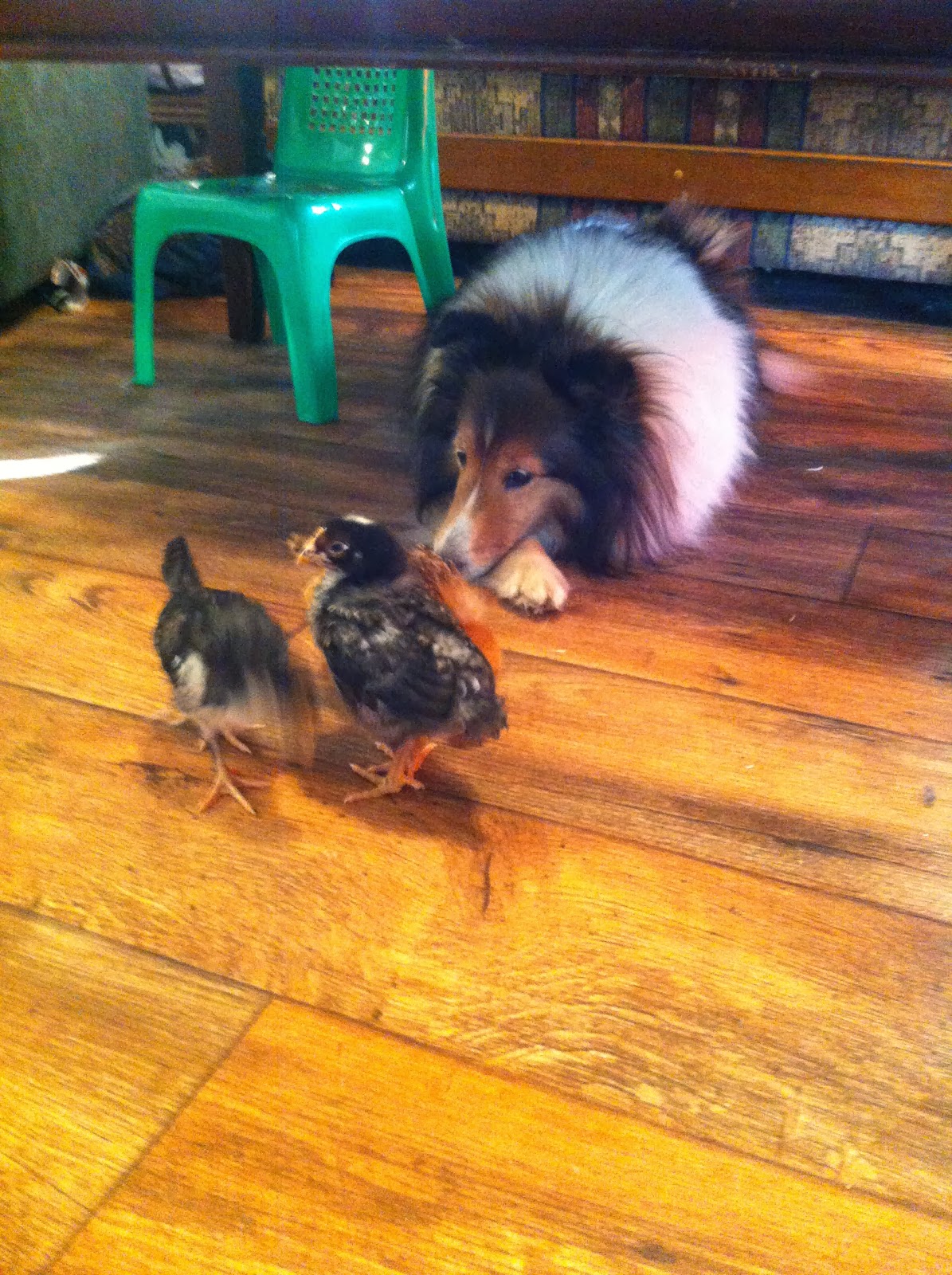
Poppet wants to eat them.  We had a moment of panic, but it was resolved without mishap.


This little girl was having some out time issues, so I put her back in her pen.
Chicks are social creatures and hate to be alone.  This little but is no different.
She chirped loudly until the others were brought back too.

Poppet went to her crate for some reflection time.
The chicks were much more relaxed.


Rose was very sweet. The chicks didn't really trust her though.


Domino and Labelle checking out the red baby chick


I think Little Red is confident enough with Mommy around

Half Pint really didn't want much to do with Little Red

Domino coming back

Baby Chicks, up close

Black


Wild Thing


Spot


Little Red


Aren't her wings beautiful?

Chicken Take Over!
The older crowd loves this chair so much, they don't poop on it.  
:)

Angel!

Look at him Crow!

The end.  I hope you enjoyed these pictures as much as I did taking them.  God bless you all!